FREE TEMPLATE

Construction Estimate Template

Line-item estimate with company header, customer info, scope narrative, exclusions, deposit terms, validity period, and a customer signature line. Download as PDF.

When to use this

Use this template the moment you have enough scope detail to put real numbers on paper. For most residential remodel, pool, and trade work, that is right after the site walk and the rough materials takeoff. Send it before any work starts and before any deposit is collected. The signed estimate becomes the price-and-scope foundation for the full contract.

It works for new construction, renovations, repairs, and service work. For very small jobs under a few thousand dollars, you can send the estimate as the only contract, because the signature line at the bottom converts it into an enforceable agreement for the listed scope and price.

If you currently send estimates as a text message or a verbal "I can do it for around X," switch to this immediately. The number of jobs that go sideways because the customer "thought" something was included is the single biggest controllable problem in residential construction.

What's included

Template preview

Construction Estimate

From

[Your Company Name]

[Street Address]

[City, State ZIP]

[Phone] | [Email]

License: [License #]

Bill to

[Customer Name]

[Project Address]

[City, State ZIP]

[Phone] | [Email]

Estimate #: [Number]
Date: [Date prepared]
Valid until: [Date + 30 days]
Project: [Short project name]
Project description

[One to three sentences describing the work. Example: Furnish and install travertine pool deck, replace cracked coping, resurface pool interior with Diamond Brite plaster, and install new pool light. Includes demolition and removal of existing deck pavers and plaster.]

Description Qty Unit Price Total
[Line item 1][Qty]$[Price]$[Total]
[Line item 2][Qty]$[Price]$[Total]
[Line item 3][Qty]$[Price]$[Total]
[Line item 4][Qty]$[Price]$[Total]
[Line item 5][Qty]$[Price]$[Total]
[Line item 6][Qty]$[Price]$[Total]
[Line item 7][Qty]$[Price]$[Total]
[Line item 8][Qty]$[Price]$[Total]
[Line item 9][Qty]$[Price]$[Total]
[Line item 10][Qty]$[Price]$[Total]
Subtotal$[Subtotal]
Sales tax ([rate]%)$[Tax]
Total$[Grand Total]
Deposit and payment terms

Deposit of [10]% due at signing. [30]% due upon material delivery. [40]% progress payment at [milestone]. Final [20]% due on substantial completion and punch list sign-off.

Exclusions (NOT included)

Permit fees, engineering, dumpster, port-a-john, dewatering, rock excavation, unsuitable soil removal, irrigation repair, sod replacement, electrical service upgrades beyond [scope], landscaping, fence repair, screen enclosure work, and HOA approval coordination.

Validity

This estimate is valid for 30 days from the date above. Material prices subject to change after that period. Scope and labor pricing held for 60 days.

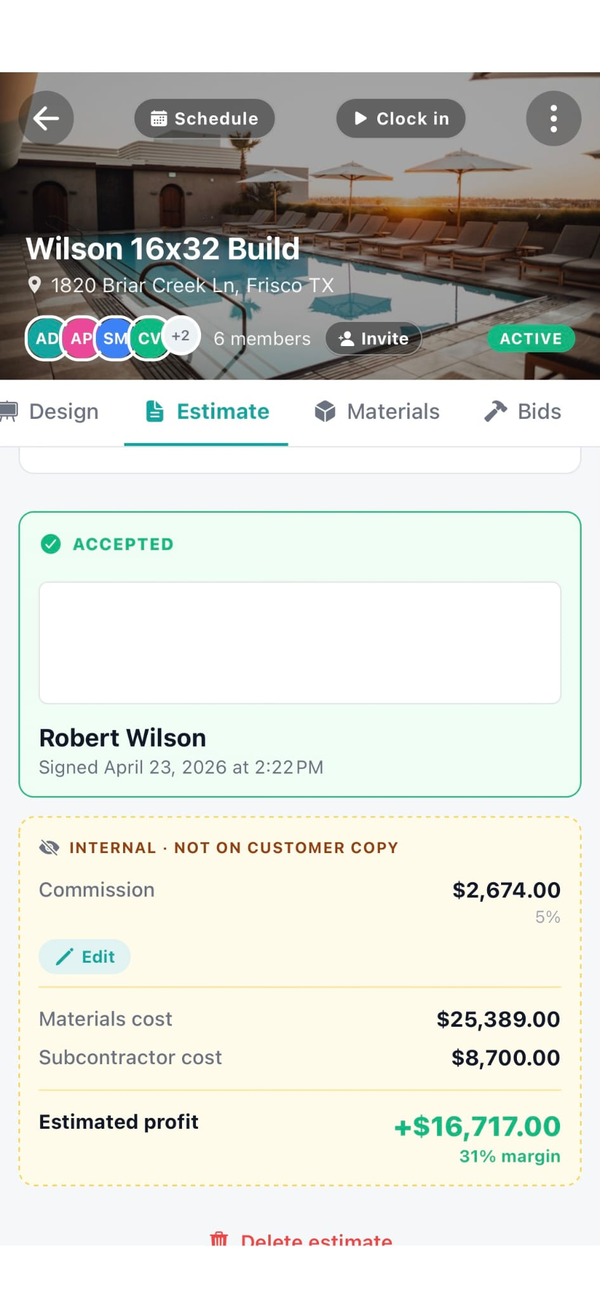
Customer acceptance: By signing below, customer accepts the scope, price, and terms of this estimate.

[Customer Name]

Date: ________________

How to customize

Start with the header block. Put your company name in bold, then your physical address (PO boxes look weak), phone, email, and contractor license number. The license number matters because Florida and most states require it on any document for licensed work. Skipping it can void the contract in some jurisdictions.

Number your estimates. Even if it is the first one, call it E-2026-0001. This tells the customer you are running a real business and gives you a tracking handle when the project becomes an invoice later. Most contractor apps including Workhand assign the number automatically.

Fill the line items with real quantities and real unit prices. "1 lump sum, $25,000" is lazy and reads that way. "1,800 SF travertine deck pavers at $14/SF = $25,200" tells the customer you know your numbers. Use whole units the customer can verify: square feet, linear feet, each, hours.

Take the exclusions section seriously. Walk your last three jobs in your head and list everything a customer assumed was included but was not. Permit fees and dumpster cost are obvious. Less obvious: sod replacement where equipment drove, irrigation repair where you dug, electrical service upgrades to meet code on a remodel. List them all. The estimate length is not the cost. The argument you avoid is the savings.

Common mistakes

Workhand auto-fills these templates from your data

Pull customer info, line items, and pricing into the estimate automatically. Add e-signature. Convert to invoice in one tap when the job is done. Free plan, no credit card.

Try Workhand free

Related templates

Frequently asked questions

What is the difference between a construction estimate and a quote?
An estimate is an educated guess at what the work will cost based on a defined scope. It can move if the scope or conditions change. A quote is a firm fixed price for a specific scope, and you are committed to it once the customer accepts. Most residential contractors send estimates, then convert to a fixed-price contract once scope is locked.
How long should a construction estimate be valid?
Thirty days is the standard. Material prices, sub availability, and your own schedule all move inside that window. The template includes a validity field so you can change it per job. For 2025 to 2026 work where supply chains are still bouncy, some contractors are quoting 14 days for the price portion and noting the scope itself stays valid for 60.
Should I show line items on an estimate or just a total?
Line items. Lump-sum estimates make customers nervous and make it harder to defend your price. Showing quantity, unit price, and total per line lets the customer see where their money goes. It also gives you a cleaner path to changing scope mid-job because you can point to the specific line that moved.
What exclusions should I list on a construction estimate?
Anything common that customers assume is included but is not. Examples: permit fees, engineering, dumpster, port-a-john, dewatering, unsuitable soil removal, rock excavation, irrigation repair, sod replacement, electrical service upgrades. Write them out. The number of fights you avoid is worth the line of text.
Do I need a customer signature on an estimate?
Yes. A signed estimate becomes a contract for that scope and price. Even if you intend to convert to a longer contract later, get the signature on the estimate so you have documented acceptance of the scope and price. The template has a signature line at the bottom for this reason.
How much deposit should I require on a construction project?
In Florida, contractor deposits are capped at 10 percent unless you have a stored materials provision or you are subject to a specific exemption. Many residential contractors collect 10 percent at signing and 30 to 40 percent at material delivery, with progress draws after that. Adjust to your state and to your cash needs.