Feature · Pool industry

Pool Chemical Logs: Built by a Pool Builder, Stuck in Your Pocket

Nine chemistry fields per visit. Plaster startup tracking for new builds. Warranty defense when a customer claims the plaster failed because of bad chemistry. Customer portal view so homeowners see what was tested and dosed. Works offline at the equipment pad. Built for pool builders and weekly route service crews who currently log everything on a clipboard or not at all.

Get Workhand free See pricing
Quick answer: Workhand tracks 9 chemistry fields per pool visit (pH, FC, CC, CYA, Ca hardness, TA, salt, phosphate, water temp) plus dosing in liquid chlorine, cal-hypo, salt, CYA, and notes. Plaster startup mode handles the 28-day cure tracking. Customer portal shows the homeowner each visit. Warranty defense via timestamped logs. Multi-pool per customer. Works offline. Included on all paid plans starting at 34.99 per month.

The problem this solves

Two pain points, same software: pool builders defending plaster warranties, and route service crews proving they did the work.

For builders: a customer calls 18 months after the build. The plaster is mottling, the surface looks streaky, or there's surface delamination. They blame your startup chemistry. The plaster manufacturer says the failure is consistent with high pH during cure. Without records, you have no way to prove pH was in range every day of the 28-day startup. You either eat a $15,000 re-plaster or get into a fight with the customer that ends with a bad review and possibly a lawsuit. One missing chemistry log costs more than a year of subscription fees on every contractor SaaS combined.

For route service: the homeowner says you skipped a visit, or only stayed five minutes, or "the chlorine has been weird so you must not be testing." Without per-visit chemistry logs that the homeowner can see, the trust collapses. The customer cancels service. You lose a $200-a-month recurring account because there was no record proving you did the work.

The duct-tape fix is a paper clipboard or a generic notes app. The clipboard works until it gets wet. The notes app works until the tech forgets to send it.

How Workhand handles it

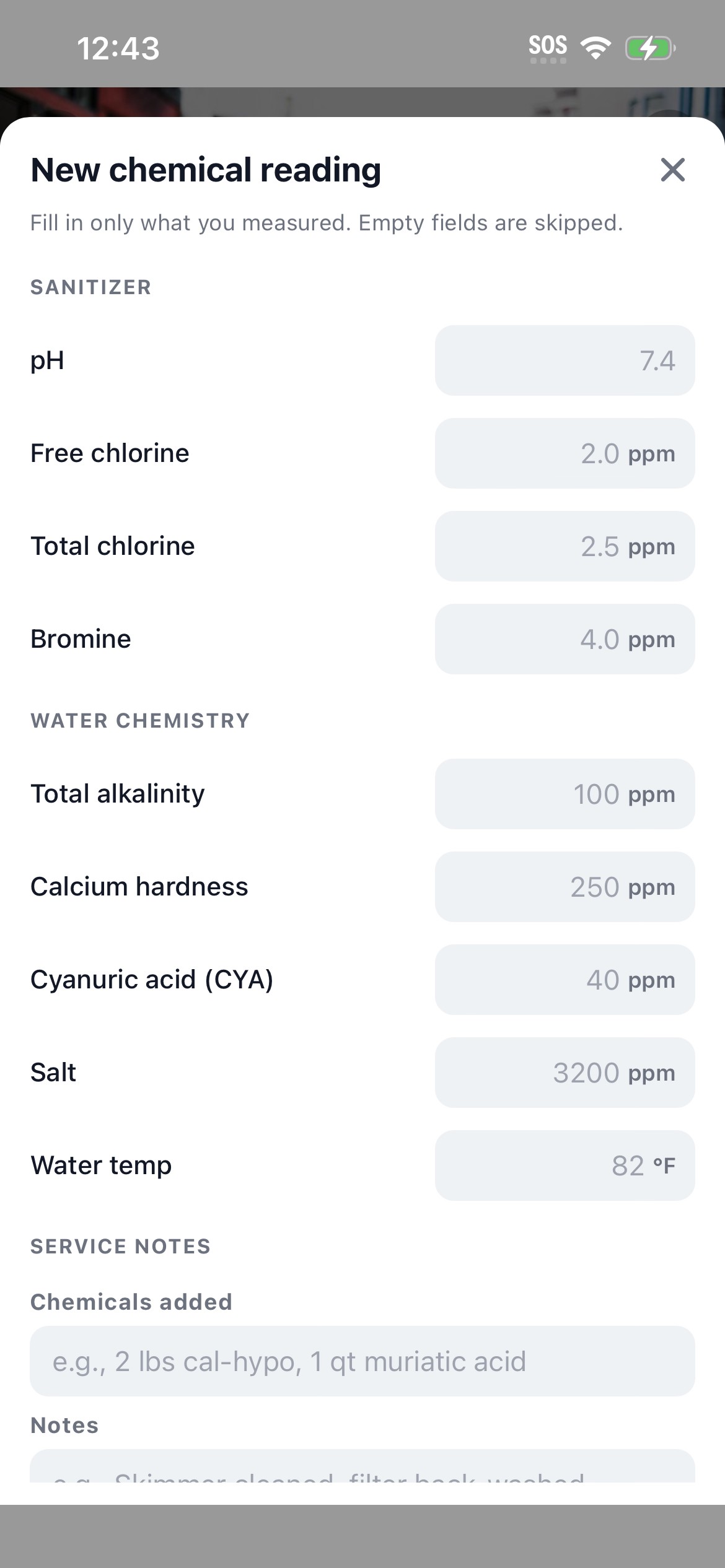
Open the pool job in the app. Tap "Log visit." The chemistry form has every field a pool tech needs: pH, free chlorine, combined chlorine, cyanuric acid, calcium hardness, total alkalinity, salt, phosphate, and water temperature. All inputs accept the formats techs already use. Optional photo of the test strip or DPD comparator. Timestamp + GPS attached.

The dosing side captures what you added: gallons of liquid chlorine, pounds of cal-hypo, pounds of salt, pounds of cyanuric, and free-text notes for everything else. Save. The log is now permanent and shared with the customer's portal if you have that enabled.

For new pool builds, switch the job into plaster startup mode. The app prompts for daily readings during the 28-day cure. The plaster manufacturer's target ranges show right next to each field so you know if a reading is out of spec. At day 28, the cure log gets archived as warranty documentation tied to the build.

Everything works offline. The most common place a tech needs to log a reading is the equipment pad with one bar of LTE, in a screen room with concrete walls. Workhand caches the entry and syncs when signal returns. Same workflow either way.

Chemistry fieldWhy we track it
pHMost actionable reading. Drives plaster cure, equipment scale, chlorine effectiveness.
Free chlorine (FC)Active sanitizer level. Has to stay in range to keep water safe.
Combined chlorine (CC)Chloramine load. High CC means the water needs a shock or breakpoint chlorination.
Cyanuric acid (CYA)Chlorine stabilizer. Too low and outdoor chlorine burns off in hours. Too high and chlorine becomes ineffective.
Calcium hardnessScale formation and plaster protection. Low calcium can leach calcium from new plaster.
Total alkalinity (TA)pH buffer. Bounces around in new plaster pools, predictor of pH drift.
SaltCritical for salt chlorine generators. Low salt means the cell is not making chlorine.
PhosphateAlgae fuel. Watching phosphate is the cheapest algae prevention method.
Water temperatureDrives chemistry kinetics. Warm water consumes chlorine faster, drops pH faster.

Why the warranty case alone pays for the app

A re-plaster on a 16x32 inground runs $7,500 to $12,000 in materials and labor depending on finish. A high-end pebble surface re-do can hit $25,000. If you do 30 builds a year and eat one false warranty claim every 18 months because you can't prove chemistry was in range, that single saved claim pays for the app for the next 25 years.

The defense argument is simple. You hand the homeowner (or the plaster manufacturer's warranty rep) a chronological chemistry log from the 28 days of plaster cure plus the 90 days of weekly visits after. Every reading is timestamped. Most are in range. The few that drifted got dosed back the same visit. The failure mode the plaster shows is not consistent with the chemistry you ran. The warranty claim gets denied at the manufacturer, the customer's complaint shifts to the plaster manufacturer or another cause, and the builder is out of the line of fire.

Without the log, none of that argument can be made. With the log, it is a 10-minute conversation.

Who this is built for

Try Workhand free

Pool chemical logs included on all paid plans. Pro at 34.99 per month for solo. Team at 89.99 per month for crews. 14-day free trial.

Get the app See pricing

Common questions

What chemistry readings does Workhand track per pool visit?

Nine fields per visit: pH, free chlorine (FC), combined chlorine (CC), cyanuric acid (CYA / stabilizer), calcium hardness, total alkalinity (TA), salt, phosphate, and water temperature. All optional except whichever the company sets as required in Settings. Most pool service crews log pH, FC, CC, CYA, salt, and TA on every visit and the rest weekly or as needed. The dosing side captures gallons of liquid chlorine, pounds of cal-hypo, pounds of salt, pounds of CYA, and notes.

Does the app handle plaster startup tracking for new pool builds?

Yes. When you mark a build job as in the plaster cure window, the app prompts for daily readings during the 28-day startup period. pH and total alkalinity move fast in those first weeks as the new plaster leaches calcium hydroxide, and the cure log is what protects the plaster warranty. The log keeps a clean record that the chemistry stayed inside the manufacturer-spec range every day so any future warranty claim has documentation.

How does this help with warranty defense?

Pool builders eat false warranty claims constantly. Customer calls 18 months in, says the plaster is mottling because of bad chemistry, demands a free re-plaster. Without records the builder either eats the cost or fights the customer with no documentation. With Workhand's pool chemical log, every visit is timestamped, the chemistry numbers are recorded, and the builder can show: chemistry was in spec on these 47 visits, the failure is from a different cause. That single document saves five-figure repairs.

Can customers see the chemistry log?

Yes. Workhand's customer portal shows the homeowner each visit's chemistry readings and dosing. They see what was tested, what the numbers were, and what chemicals were added. This is huge for trust. Most homeowners do not know what good pH or chlorine looks like and have no way to verify the route tech actually tested water. Showing them every reading proves you are doing the work. It also reduces complaint calls because the homeowner can self-serve looking at recent visits.

Does the chemical log work offline?

Yes. The most common place to test water is at the equipment pad with no cell signal. Workhand caches the reading on the device, the tech logs everything they need, and the log syncs the moment the phone gets a signal again. Same workflow whether you have LTE or you are in a screened-in pool enclosure behind concrete.

Can one customer have multiple pools?

Yes. Pool builders with phased projects (main pool plus spa, separate kids pool, water feature) can log per-pool chemistry under one customer. Route service can handle a property with a pool and a spa as separate logs too. The customer record stays unified for billing and chat but the chemistry log is per-water-body so the numbers do not mix.

Does Workhand replace a Taylor or LaMotte test kit?

No. Workhand records the readings you took with your test kit. The app does not test water. It is the logbook. A Taylor K-2006 or a LaMotte ColorQ Pro is still how you get the numbers. Workhand is what you do with the numbers once you have them.

Does this cost extra?

Pool chemical logs are included on all paid plans. Pro at 34.99 per month gets you the full chemistry log, plaster startup tracking, customer portal view, and dosing fields. Team at 89.99 per month adds team chemistry tracking across multiple crews. Free plan supports running one active job with basic logging.