The problem this solves
Roughly 30 percent of US construction workers are Hispanic, and in states like Florida, Texas, California, Arizona, and Nevada that number climbs to 45-60 percent. Most small construction crews end up with the same setup: half the field staff is Spanish-speaking, the office staff is not, and somewhere in the middle one bilingual foreman becomes the entire translation chain.
That bilingual foreman is a single point of failure. When they quit, take a vacation, get pulled to a different jobsite, or simply miss a phone call, the translation chain breaks. Schedules get missed. Mistakes happen. Workers feel disrespected because nobody is talking to them in their language. The office feels frustrated because instructions are not being followed.
The duct-tape fix most crews use: copy a message into Google Translate, paste the result into a group text, hope it comes out right. It works for a single message. It does not scale to 10 jobs a week with dozens of messages per day per job.
How Workhand handles it
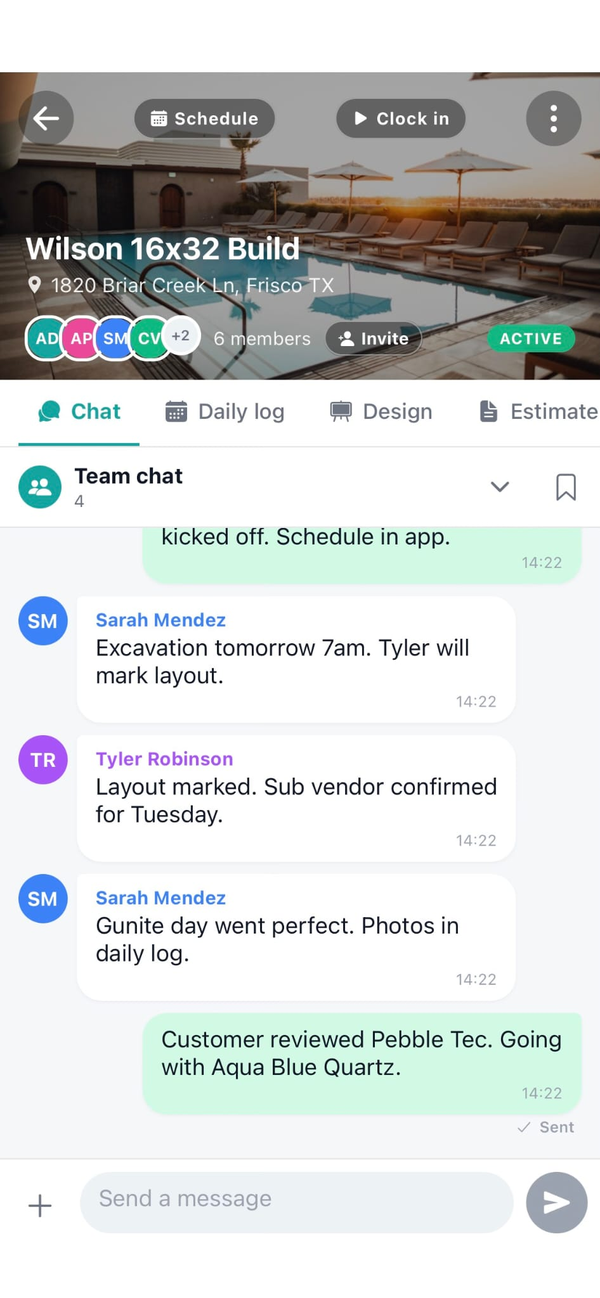
Every message in per-job chat has a translate icon. Tap it once and the message converts. English in, Spanish out, or Spanish in, English out. The translation appears inline below the original message, so both versions stay visible. Anyone reading the thread later sees the original wording and the translation side by side.
The chat itself is scoped to one job. Owner, employees, subcontractors invited to that specific job, and any sales staff can see and reply. Customers do not see this thread (that is what the customer-facing job portal is for). The translation runs on Google's translation infrastructure, so language pair quality is comparable to what you would get pasting into translate.google.com.
| What you get | How it works |
|---|---|
| One-tap translation | Translate icon on every message. Single tap converts. Both versions visible. |
| Bidirectional EN/ES | English-to-Spanish and Spanish-to-English supported equally. |
| Photo + text context | Translation appears alongside photo attachments so visual context is preserved. |
| Scoped to one job | Per-job chat. Only people invited to that job see the thread. |
| Subs included | Subcontractors invited to a job get translation by default. No extra setup. |
| No cap, no add-on | Unlimited translations on every plan including Free. No per-translation cost. |
| Searchable history | Translation history preserved with the job record for future reference. |
Why this matters more than other field-service features
Most construction software treats Spanish translation as an add-on or an afterthought. Workhand built it into the core chat experience because the field reality is that bilingual communication is not optional for the majority of small contractors in major construction markets.
Three specific reasons this is bigger than it looks:
- Workers do their best work when they understand the instruction. A clear translated message about which way the rebar runs prevents a $4,000 rework. Cumulative across a year, the translation feature pays for itself many times over.
- Subcontractor relationships compound. Spanish-speaking subs return calls faster from contractors who can communicate in their language. Better subs means better jobs means better margins.
- Documentation in two languages is legal protection. When a dispute happens months later, the translated chat history shows what was actually agreed. A Spanish-speaking worker cannot later claim they were not properly instructed because the translation is right there in the record.
Who this is built for
- General contractors running residential jobs with mixed-language crews
- Pool builders in Florida, Texas, Arizona where Hispanic labor is the majority
- Landscapers and concrete contractors where seasonal crews are heavily Spanish-speaking
- Roofers who lean on Spanish-speaking subcontractor crews for the bulk of installation labor
- Painters, drywall, and finish trades with bilingual sub crews
Try Workhand free
Free plan includes per-job chat with Spanish translation on 1 active job. Upgrade to Pro at $34.99/mo for unlimited jobs.
Get the app See pricingCommon questions
How does Spanish translation work in Workhand?
Every message in per-job chat has a translate icon. Tap it to convert an English message to Spanish or a Spanish message to English. The translation appears inline below the original message. Both versions stay visible so anyone reading the thread later can see the original wording and the translation.
Which languages does Workhand support?
English and Spanish at launch. Portuguese is partially supported in some surfaces. Other languages are on the roadmap based on contractor demand. The translation runs on Google's translation infrastructure so the language pair quality is comparable to Google Translate's web product.
Does Spanish translation cost extra?
No. Translation is included on every plan, including the Free plan. There is no per-translation cost, no monthly cap, and no separate add-on. Subcontractors invited to a job inherit the same translation capability automatically.
Can the customer see translated messages?
Per-job chat is internal to your team and any subcontractors invited to the job. Customers do not see the chat thread. The customer-facing job portal is a separate surface that shows photos, progress, and selections, not the team chat.
What languages can construction subcontractors communicate in?
Subcontractors invited to a Workhand job get the same per-job chat with one-tap English-Spanish translation. A Spanish-speaking sub can type in Spanish and the English-speaking office staff sees the English translation inline. The original Spanish stays visible so context is preserved for native readers and for record-keeping.
Is the translation accurate enough for construction terminology?
Translation accuracy for construction terms is generally good but not perfect for technical jargon. Common job-site words (concrete, rebar, plumbing rough-in, drywall, framing) translate cleanly. More specialized vocabulary may need clarification. The original-plus-translation display means the native speaker can correct any obvious mistranslation in the next message.
Does Spanish translation work offline?
Translation requires an internet connection because it runs through Google's translation service. Most jobsites have cellular coverage, but rural sites without coverage will see translation fail until the connection returns. Messages themselves still send and queue offline, the translation just delays until connectivity returns.